|
Professional development & events
Writing the History of U.S. Foreign Relations in an Age of CrisisYale University, New Haven, CT | June 21–25, 2025 Facilitators: Alvita Akiboh (Yale University) & Michael Brenes (Yale University) ![]() About the 2025 Summer InstituteThe largest land war in Europe since World War II, looming conflict with China, war in Gaza, and instability in states such as Haiti, Syria, and Afghanistan have fundamentally reshaped global affairs. These conflicts exist alongside unprecedented rates of economic and racial inequality, the escalating havoc wrought by climate change, and the reemergence of autocratic figures in the United States and around the world. Indeed, the world is currently embroiled in what commentators have called a “polycrisis.” These crises present challenges and opportunities for historians of U.S. foreign relations to explore the origins of our current moment, to offer scholars and the public nuanced perspectives on how to understand our world. Yet the historical profession—and the humanities broadly—is in the throes of its own crisis. Decades of austerity, neglect, and precarity have eroded the historical discipline—and the ranks of historians— with many scholars of U.S. foreign relations unable to secure tenure-track positions or produce enduring scholarship in alternative careers. Key QuestionsIn this light, we ask crucial questions about the role of historians of the United States and the world at this critical juncture:
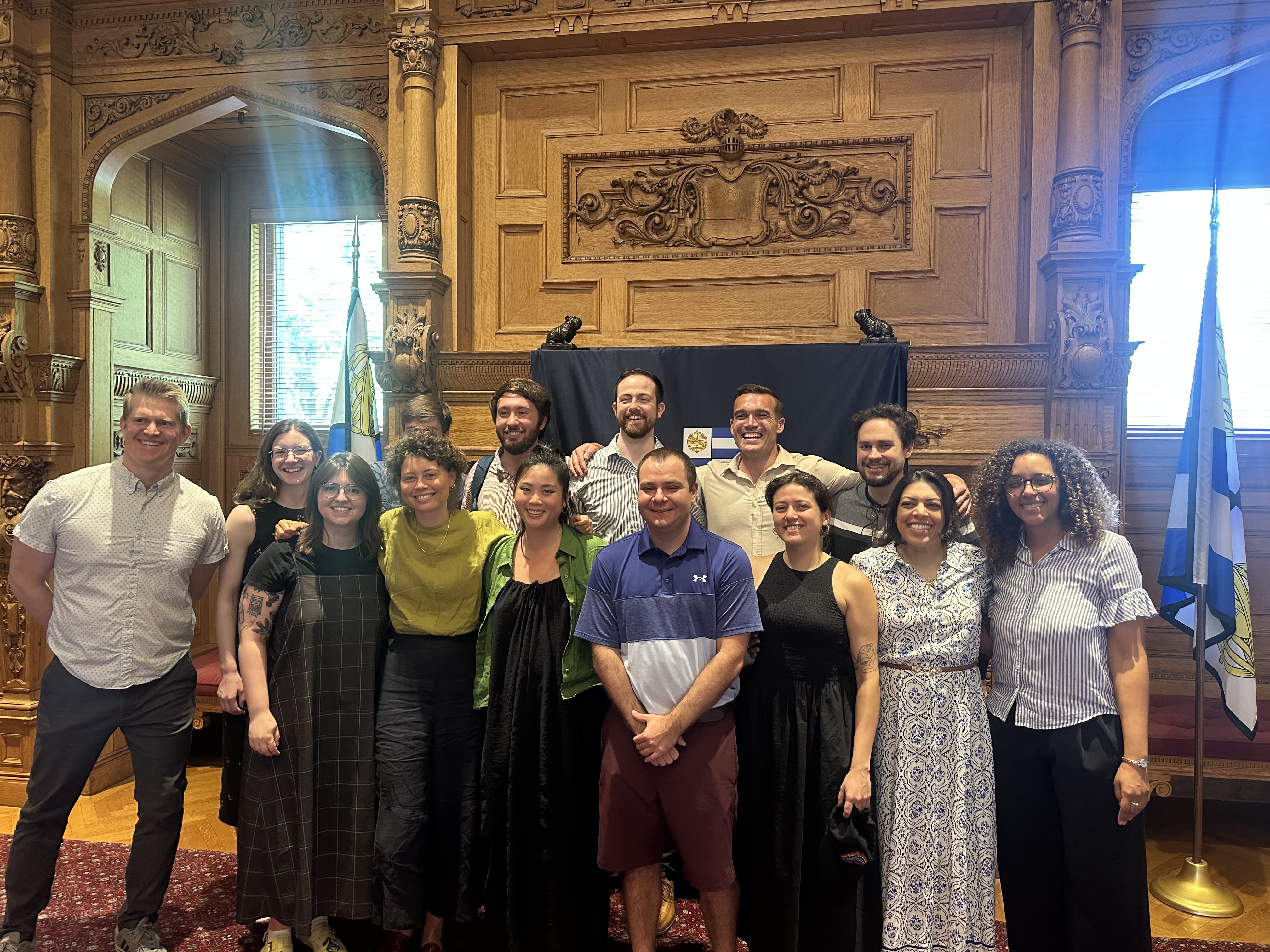
We will seek to answer these questions and others, while also helping a cohort of young scholars to develop sophisticated and nuanced perspectives that will shape their work on the inevitable crises of the future. ParticipantsIntroducing the 2025 Cohort Benjamin AllisonUniversity of Texas at Austin Benjamin V. Allison is a PhD Candidate in History at the University of Texas at Austin, where he specializes in US foreign and national security policy since 1945, especially toward the Middle East and Russia. He also studies terrorism, insurgency, and proxy war. Ben's dissertation focuses on relations between the United States, the Soviet Union, and the Steadfastness and Confrontation Front—a group of Arab entities (Syria, Algeria, Libya, South Yemen, and the Palestine Liberation Organization) that opposed the Egyptian-Israeli peace process—from 1977 to 1984. His scholarly articles have been published by Cold War History, Perspectives on Terrorism, and the International Centre for Counter-terrorism, and he has bylines at Foreign Policy, Lawfare, The Hill, Inkstick, The Chronicle of Higher Education, and elsewhere. He hopes to be a scholar-practitioner. Yoram CarboexNorwegian University of Science and Technology Yoram Carboex is currently a PhD candidate at the Department of Modern History and Society at the Norwegian University of Science and Technology (NTNU) in Trondheim. His research focuses on the history of deep-sea mining (1968-1994). He is interested in the way a newfound interest in mining mineral resources from the deep ocean led to intense international political negotiations and legal discussions to shape a new regime regulating the extraction of minerals in the deep seabed. He has published about this topic in Environmental History and other peer- reviewed academic journals. Apart from deep-sea mining, he has a broader interest in the international and environmental history of the ocean in the post-war period. Before commencing his PhD, he worked as a teacher at the Faculty of Arts and Social Sciences at Maastricht University (2019-2022), where he taught courses across the humanities and social sciences. Grace EasterlyUniversity of Connecticut Grace Easterly is a PhD Candidate at the University of Connecticut studying how the concepts of the freedom of navigation and maritime sovereignty evolved during the second half of the twentieth century in an era of decolonization, Cold War, US naval dominance, and expanding maritime shipping. Prior to joining the UConn community, she was a Program Coordinator and Research Assistant at the Stimson Center. She graduated summa cum laude from NYU’s Gallatin School of Individualized Study with a BA focusing on International Political Economy and Geography and a minor in French. Victoria Gonzalez MaltesEcole des Hautes Etudes en Sciences Sociales Victoria Gonzalez Maltes is a doctoral candidate in History at the Ecole des Hautes Etudes en Sciences Sociales in Paris, France and a scholar of American immigration history. She is French- American and has lived in the United States for several years, first as a fellow at Harvard University, and currently as a visiting scholar at the University of Pennsylvania’s History Department. She is an incoming (2026) postdoctoral fellow at the United States Holocaust Memorial Museum. Her research examines the processes of selection and exclusion of refugees seeking resettlement through the U.S. Displaced Persons Program. Her postdoctoral research will expand the temporal frame of the dissertation to examine medical exclusion as a result of persecution for Jewish refugees seeking refuge in the United States during the Holocaust. Hayden KolowratIndiana University-Bloomington Hayden Kolowrat is a PhD candidate in history at Indiana University-Bloomington. He also holds an MA in History from Indiana and an MA in Southeast Asian Studies from the University of Wisconsin-Madison. His dissertation research focuses on the United States' foreign policy of colonial military service beginning in the U.S. territories in 1898 and extending into Cold War military advising missions. He is also currently an editorial assistant at the Journal of American History. Thomas PelchatSouthern Methodist University Thomas Pelchat is a PhD candidate at Southern Methodist University. His research interests include United States diplomatic history during the cold war and energy history. His dissertation studies the United States’s Cold War energy empire and its demise by examining the 1981-82 Reagan Siberian Pipeline crisis. Thomas earned his M.A. from the University of New Hampshire in 2020 and his bachelors at Gettysburg College. Aimée PlukkerCornell University Aimée Plukker is a PhD Candidate in History at Cornell University. She is currently finishing a dissertation titled Europe Calling: Cold War U.S. Tourism and the Production of “the West,” a transnational and comparative history of how the tourism industry contributed to the reinvention of “the West” as a geopolitical category combining the U.S. and Western Europe. Opposed to the Communist “East,” “the West” entailed notions of liberal democracy and freedom, capitalist internationalism, modernization, and ideals for the future. Focusing on U.S. tourism to Rome, Berlin, and Amsterdam between 1945 and 1970, her research reveals in what ways policymakers, advertising agencies, and the culture industry reshaped “the West” as a material and imagined space, how it was experienced by tourists, and its wider impact on local social relations. Her research is forthcoming and has been published in Radical History Review, Journal of Material Culture, and various anthologies. She is also the Reviews Editor of the Journal of Tourism History. Sean RamingUniversity of Notre Dame Sean Raming is a PhD candidate in History and Peace Studies at the University of Notre Dame's Kroc Institute for International Peace Studies. His dissertation examines organized labor in defense manufacturing during the Cold War. He was a 2024 Smithsonian National Air and Space Museum Guggenheim Doctoral Fellow and worked for two years as an editorial assistant at Modern American History. Rashida ShafiqSouthern Methodist University Rashida Shafiq is a PhD Candidate at Southern Methodist University focusing on gender, politics, and foreign relations during the Cold War. The working title of her dissertation is “From Toledo to Tamil Nadu": A Study of Gloria Steinem in India, 1957-1959,” which argues that if it weren’t for her inaugural trip to India in 1957, her feminist politics would be much different from what they are today. Another one of her interests is analyzing the complex relationships between American Cold War Presidents such as Dwight Eisenhower, John Kennedy, Lyndon Johnson, and Richard Nixon with the first female prime minister of India, Indira Gandhi. Rashida is fluent in Gujarati, Hindi, Urdu, Arabic, and Swahili. She lives in Dallas with her husband and two children. Alex SouthgateTemple University Alex (she/her) is a Ph.D. Candidate in the Department of History at Temple University where she is also completing the Graduate Certificate in Gender, Sexuality, and Women’s Studies. She received both her B.A. in History and M.A. in Contemporary International History from the University of Toronto. Alex is broadly interested in twentieth-century international relations and cultural history. Her dissertation, entitled “Speak Truth to Global Power,” focuses on Quaker transnationalism during the early Cold War and explores the relationship between religious pacifism and diplomacy. Her research is supported by Canada’s Social Sciences and Humanities Research Council (SSHRC) Doctoral Fellowship. Alex is currently a Graduate Student Representative on SHAFR’s council and is a member of the Committee on Digital Resources and Archival Sharing. Alongside her historical research, Alex is passionate about editorial work and archival studies. She is currently an Assistant Editor for Diplomatic History and has previously worked for Rise Up! Feminist Digital Archive and Canada Declassified. In 2024 she edited a collection about feminist archives for Rejoinder, an online journal published by Rutgers’ Institute for Research on Women, entitled “The Archival is Political.” Jack WernerUniversity of Maryland, College Park Jack Werner is a Ph.D. Candidate in History at the University of Maryland, College Park. His dissertation is a disability and labor history of the U.S. colonial rule over the Philippines, 1898- 1919. He has published in the Journal of Military History and TIME’s Made by History. Sally YiPrinceton University Sally Yi is a third-year doctoral candidate in the History department at Princeton University, advised by Professor Beth Lew-Williams. She is interested in the interconnected histories of foreign relations, law, and business. Before coming to Princeton, Sally received her undergraduate degree in Studies of Women, Gender, and Sexuality at Harvard College and completed the Undergraduate Teacher Education Program at the Harvard Graduate School of Education. After college, Sally worked in Human Resources at two multinational investment firms, where she helped organize both companies’ inaugural affinity groups for Asian American and Pacific Islander employees and allies. Her dissertation project, “Capital Conquest: Japanese Investment in Postwar Seattle,” puts the contemporaneous domestic and international racialization of Japan and Japanese people in conversation with one another. It uses the legal and cultural implications of foreign ownership of different types of American property throughout the postwar period to investigate how Japanese foreign investment influenced Japanese Americans' political, economic, and cultural inclusion during the Civil Rights Movement and beyond. In addition to her work about Japanese Americans in Seattle, she is fascinated by the tensions amongst international, national, and local governments more generally, which she explores through local Seattleites’ responses to the 1999 World Trade Organization Ministerial Conference. |